
Spring Awakening: A Nature Journaling Guide to UK Woodlands
Spring in a British wood does not arrive all at once. It stutters. One week the hazel catkins are swinging over a path you had forgotten about; a fortnight later the same path is edged with the first sheen of wood anemone. Miss two visits and you have missed a chapter. That is the best argument for keeping a nature journal: not to record everything, but to keep a thread running between visits so the season reads as a sequence rather than a blur.
What follows is a rough order of events from January to late May, with notes on what to look for and prompts to fill a page even on a grey day when nothing much seems to be happening.
Start with the calendar, not the checklist
Spring runs later the further north you go and the higher you climb. A wood in Cornwall can be a fortnight or more ahead of one in Perthshire, and within a single wood the south-facing edge, the sunny ride and the cold bottom of a gully all move at different speeds. Treat any list of flowering dates as a range, not a timetable.
The most useful habit is to choose one short stretch of path — ten minutes' walking, no more — and return to it weekly. Write the date, time, weather and rough temperature at the top of the page, then note five things that have changed since your last visit. Five is enough. Comparing the same ground week after week will teach you more than a dozen trips to new places.
Buds and catkins: the trees go first
Trees cannot hide, which makes them the honest start of a spring journal. Learn a handful of buds and you can read a winter wood with confidence.
- Hazel — yellow lamb's-tail catkins from midwinter, often the first thing to catch the eye.
- Alder — long catkins too, but purple-brown, with small cones left over from last year on the same twig.
- Ash — unmistakable soot-black buds, velvety to the touch, sitting opposite each other in pairs.
- Oak — clusters of knobbly brown buds crowded at the tips of the twigs.
- Beech — long, narrow, coppery buds, sharp-pointed and held away from the stem.
- Blackthorn — white blossom on bare black twigs in March or early April, before a single leaf.
Try drawing one twig from the same tree every week, in a strip across two pages. By May you will have a record of bud burst, leaf unfurling and the first flush of green, all from a single branch.
The woodland floor, in sequence
Woodland flowers work to a rough order, though timing shifts with latitude and altitude.
- Snowdrop and winter aconite — January into February, often near old gardens, churchyards and estate walls.
- Lesser celandine — starry yellow flowers above glossy, heart-shaped leaves, from February.
- Primrose — pale yellow on banks and verges; the first bumblebee queens are usually not far behind.
- Wood anemone — white stars that open in sun and close in cloud, often in drifts by late March.
- Dog's mercury — a green haze over the ground, easy to overlook because it has no petals.
- Wild garlic — you will smell it before you see it; white star flowers over broad leaves in April.
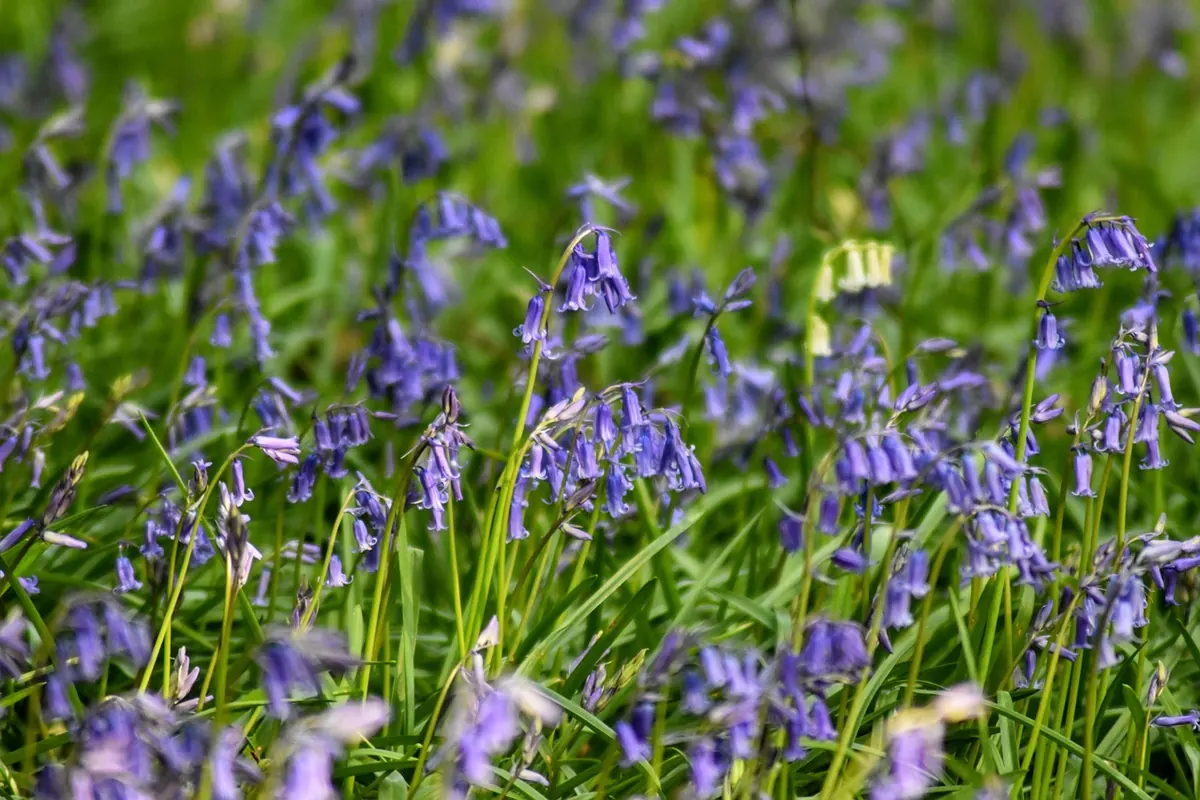
- Bluebell — late April into May, the colour of the season when it is at its height.
Note the state of the canopy as well as the flowers. Bluebells and anemones do their work in the window between the soil warming up and the leaves closing overhead.
What the flowers hint at
Some woodland plants spread slowly and rarely colonise new ground. Where bluebell, wood anemone, dog's mercury, wood sorrel, herb Paris or wild service tree grow together, the wood is likely to be old — long-established rather than planted in the last century or two. It is a hint, not proof, but it turns a walk into a question: how long has this place been wooded?
Sketch a simple map of your patch and mark the drifts of each species on it. Two or three seasons of that map will show you more about the wood's history than any single visit.
Sound, smell and movement
By March the wood is loud. Chiffchaffs arrive and repeat their name from the treetops; great spotted woodpeckers drum on dead branches; blackcaps and willow warblers follow in April. Brimstones and orange-tips are the classic spring butterflies, and a queen bumblebee buzzing low over the leaf litter is a sign she is hunting for a nest site.
Two methods work well on the page. The first is a sound map: draw a small circle for yourself, close your eyes for two minutes, and mark where each sound comes from. The second is a smell note — wild garlic, wet bark, bluebell, leaf mould after rain. Specifics beat adjectives. "Green and damp" says little; "like the inside of a mushroom" says a great deal.
Prompts for a spring page
When the wood feels quiet, pick one of these and answer it in five lines.
- What has changed since my last visit to this exact spot?
- Match one colour precisely, without using the plant's name.
- Draw a sound map, or write three sounds and where they came from.
- Sketch a single square metre of ground, including moss and dead wood.
- Which tree is furthest ahead, and which is holding back?
- Write down one question to answer next time.
Write the sentence "The first thing I noticed today was…" and finish it before you take out your phone.
Keeping a spring notebook you will actually use
A small hardback notebook, a pencil and a rubber band to hold it shut in the rain will do more than an expensive kit. Start each entry with place, date, time and weather, and leave a blank half-page for a return visit — spring pages fill up fast with second looks.
Photograph anything you cannot identify and sketch it at home; identification is easier with a field guide, a hand lens and no midges. Stay on paths in reserves and sensitive woods, and pick nothing: some plants are legally protected from picking or uprooting, and a photograph or drawing lasts longer anyway. From April, long trousers and a tick check at the end of the day are sensible habits; if you find an attached tick and are unsure how to remove it, ask a pharmacist or your GP. Keep dogs close or on a lead where ground-nesting birds are about between March and July.
Then go back next week. The point of the notebook is not the perfect page — it is being there when the wood turns green.
Photo: JonathanKnight / Pixabay